Not Every Ghost Rides a Horse
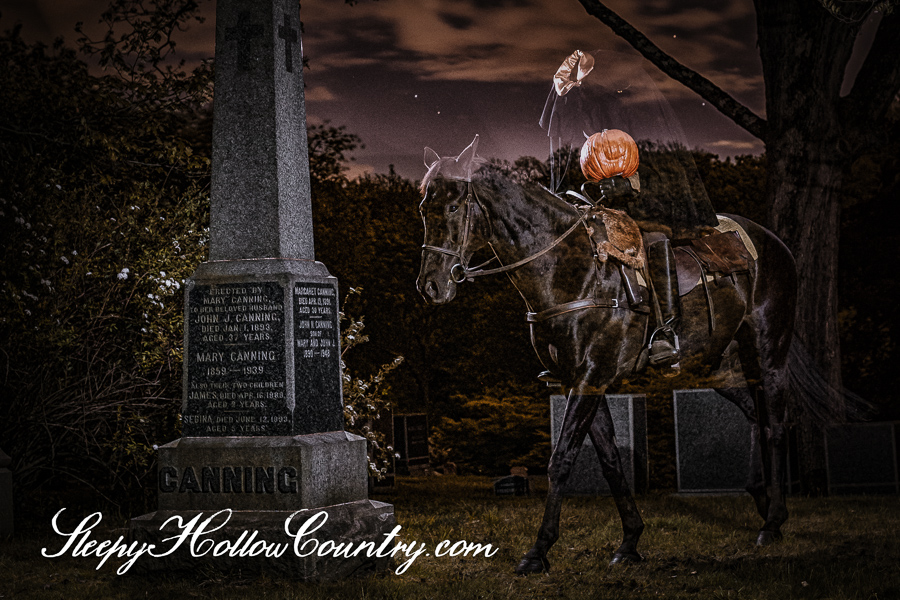
When most people think of ghosts in Sleepy Hollow Country, their minds gallop straight to that most famous of specters—the Headless Horseman, eternally thundering through the darkness in pursuit of a hapless schoolmaster. And who can blame them? Washington Irving’s tale has cast such a long shadow over this region it is easy to forget the Hudson Valley was already thick with ghost stories long before Ichabod Crane ever set foot in a schoolhouse.
The truth is, the Horseman may be the most famous phantom to haunt these hills but he’s far from alone. For every tale of hoofbeats on Old Sleepy Hollow Road, there are a dozen quieter hauntings tucked away in forgotten corners—spirits who linger in crumbling estates, wander the banks of the Pocantico River, or drift through the halls of vanished buildings. These are the ghosts that get lost in the Horseman’s wake.
Perhaps it’s the very spectacle of Irving’s creation that has done such a thorough job of eclipsing the region’s other supernatural residents. A headless Hessian on a phantom steed makes for an unforgettable image while the quiet footsteps of a Revolutionary War spy or the mournful presence of a Gilded Age widow lack that same dramatic flair. But these lesser-known spirits have stories just as rooted in the soil and history of this haunted landscape.
So while the Headless Horseman continues his endless ride through popular culture, commanding the spotlight season after season, let’s turn our attention to the other side of the veil—to the phantoms who haunt without fanfare, the specters who’ve been waiting patiently in the shadows for someone to finally tell their tales. Not every ghost rides a horse, after all. Some simply walk among us, waiting to be remembered.
The Ghost of Harden Mansion
The Edward Harden Mansion, also known as Broad Oaks, was built in 1909 on North Broadway in what was then North Tarrytown by journalist-turned-financier Edward Harden. Harden had achieved fame as a Chicago Tribune reporter who broke the story of Admiral George Dewey’s victory in the Battle of Manila Bay during the Spanish-American War, scooping even the official military report by paying a telegraph operator with a bag of gold. After leaving journalism for finance and earning a seat on the New York Stock Exchange, Harden married Ruth Vanderlip, sister of a prominent banker, and commissioned the architectural firm Hunt & Hunt to design the Georgian Revival mansion on four acres that included a pre-existing carriage house.
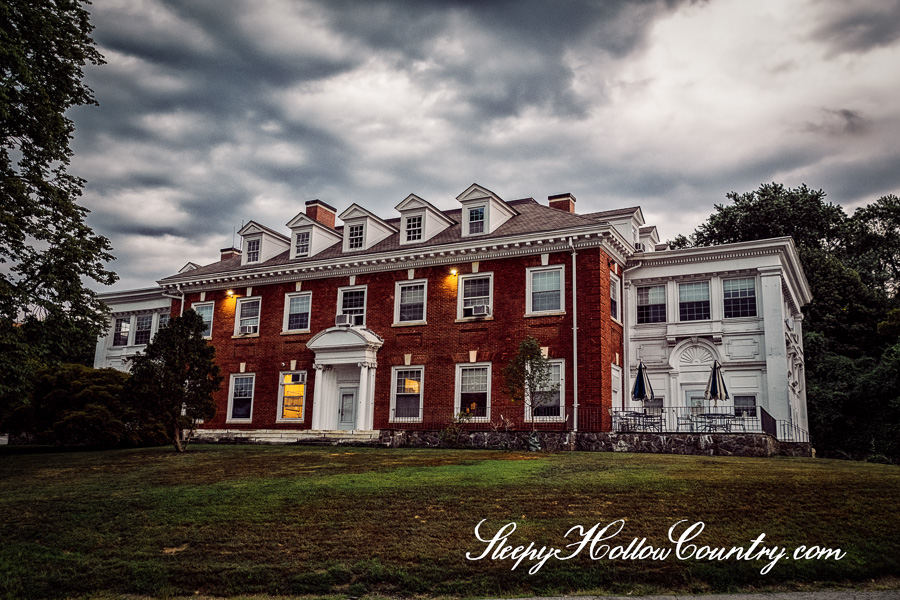
Shortly after construction Harden allowed part of his mansion to be used for a pioneering educational venture—the first Montessori school in the United States, established in 1911. After two years, the school relocated to the Vanderlip property in nearby Briarcliff Manor, where it became the Scarborough School and later educated some of Franklin Delano Roosevelt’s grandchildren. The Hardens themselves moved a couple miles up the road to Scarborough in 1926, reportedly finding Tarrytown had become too noisy.
That same year, the mansion was sold to the estate of Margaret Howard, an Irish immigrant who had become a millionaire dressmaker in New York. Howard had directed in her will that funds be used to purchase and maintain a home for retired seamstresses like those who had worked for her—an unusual philanthropic concept at the time. The Sisters of Mercy began managing the Margaret A. Howard Home for Aged Seamstresses in 1928, and the residents remained active during World War II, sewing uniforms for American troops. The Union Free School District of the Tarrytowns purchased the property in 1955 and converted it for use as its administration building, a function it continues to serve today.
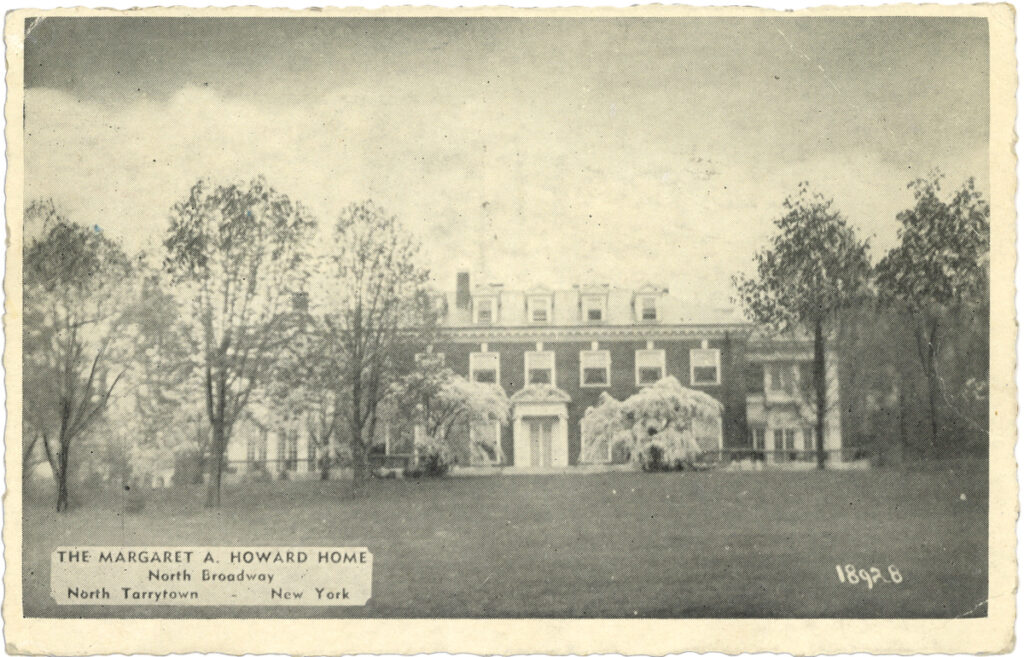
The mansion, which straddles the municipal boundary between the villages of Sleepy Hollow and Tarrytown, was added to the National Register of Historic Places in 2003 and is reportedly haunted by a ghost—none other than Margaret Howard herself—who walks the third floor. The legend of the ghostly seamstress comes to us courtesy of Cecilia Kingston who taught a folklore course at the adjoining Sleepy Hollow High School in which students collected local lore. In March of 1981, Kingston presented a compilation of the students work, titled “Folklore of the Tarrytowns”, to our local historical society. Not only did Kingston record the presence of Margaret for posterity, she herself apparently had an encounter with the ghost, telling a reporter from The Tarrytown Daily News “One night I was in the Administration building until 7:30 p.m. I heard heavy footsteps upstairs and left a few minutes later.”
However, poor Margaret is perpetually overshadowed by the school system’s mascot: the Headless Horseman. Not only is his image everywhere on campus, but the location of the Harden mansion itself is just a few yards from the location in “The Legend of Sleepy Hollow” where the ill-fated Ichabod Crane first encounters the horseman!
The Miller’s Ghost
Minna Irving’s article “In Washington Irving’s Country” offers an evocative portrait of Tarrytown, New York, as a place steeped in legend and history. Writing for The New Age Magazine in 1905, Irving explores how the town retains its Dutch colonial heritage and the romantic atmosphere that Washington Irving immortalized in his writings. She traces Tarrytown’s evolution from its earliest settlers—the Buckhouts, Requas, and Martlings—through its role as a river trading hub dependent on sloops and schooners, to its significance during the Revolutionary War, including the capture of Major André and the brutal murder of Isaac Martling that may have inspired Irving’s headless horseman legend. The author laments recent changes to historic sites like Sunnyside and the Mott House while celebrating the town’s enduring charm, describing how its hills, rocks, and woods remain populated with ghosts, legends, and stories from a bygone era.
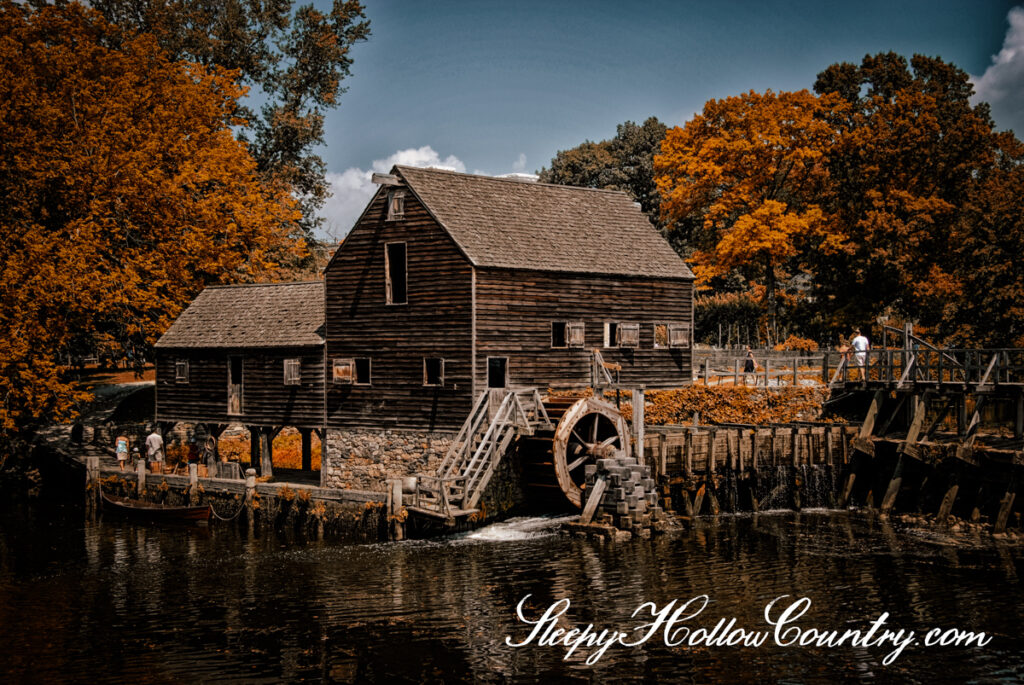
Of particular interest to us at Sleepy Hollow Country is her description of the colonial era grist mill at Philipsburg Manor in which she recounts the legend of a spectral miller: “The tottering old structure, erected at the same time as the old Dutch Church, has long been reputed to be haunted by the ghost of Caesar, an impious miller who swore that he would continue to run the mill in spite of death itself, and for many years after he passed away lights were said to be seen in the windows, and the great wheel could be heard groaning and turning all night long.”
Historical records show there was indeed a miller named Caesar at the Philipse mill. He was one of 23 enslaved people of African descent listed on an inventory of Adolph Philipse’s property drawn up after his death in 1750.
The Ghosts of Woody Crest
For years, Woody Crest had been one of the most notoriously haunted houses in the region. The two-story structure sat on a hilltop a quarter mile beyond Lyndhurst, commanding views of the Hudson River and Tarrytown below. But no tenant could bear to stay long. The cabmen who carried visitors up from the Tarrytown station knew all the neighborhood stories of the strange apparitions, spirit rappings, white hands beckoning in the night, and the moans and sighs of ghostly occupants that had driven out successive tenants of the human kind one after another.
The property belonged to railroad baron Jay Gould, but by the 1890s the house had fallen into severe disrepair. The roof and floors were rotting away—danced off by witches, if you believed the locals. The chimneys were regular hobgoblin dens, choked with rubbish, bricks, straw, and the old sticks that the witches had been riding on for years.
“Woody Crest for years has been the abiding place of ghosts. The cabman who carries you there from the Tarrytown station tells you the neighborhood stories of the strange apparitions, spirit rappings, white hands beckoning in the night and the moans and sighs of ghostly occupants of the house that have driven out successive tenants of the human kind one after another. But now the spooks have fled.”
St. Louis Post-Dispatch, February 25, 1894.
In 1893, Gould’s daughter Helen saw past the haunted reputation. The old house was beautifully situated, large and ample, and healthfully located—perfect for a Fresh Air Farm and home for crippled children. She sent for the carpenters and masons, and with saws and hammers the workmen made a raid on the ghosts. The roof and floors, which had been danced away by the witches, were replaced by new shingles and boards. The hobgoblin dens were cleaned out and freshly plastered. New coats of plaster were put on the immense high ceilings, and they say awful tall ghosts were seen there, but as one cabman noted with satisfaction, “for my part I never saw a living thing.”
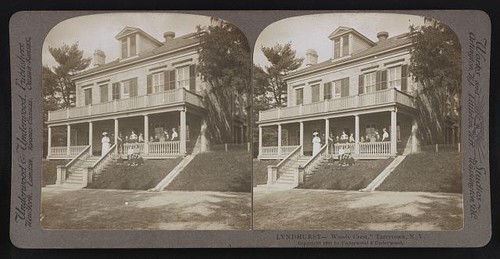
Within a year, the house had been transformed into a refuge where poor and sick children could spend summers romping in the woods and breathing fresh air. The spooks had fled.
Helen Gould’s charitable experiment at Woody Crest proved short-lived, however. The financial panic of 1907 forced her to shutter both Woody Crest and her nearby Lyndhurst Industrial School in April 1908. The building was leased to a boys’ school, and eventually fell back into disuse. The house was demolished sometime in the years following World War II and its lawns and gardens are returning to nature as part of Taxter Ridge Park Preserve.
Whether the ghosts returned after the hammers fell silent and the children departed, no one can say. But for a brief moment, the haunted house on the hill had been conquered—not by exorcism, but by the practical raid of workmen armed with saws, hammers, and fresh plaster.
Know of a ghost whose story deserves to be told—a phantom who walks rather than rides, a specter overshadowed by more famous neighbors? We’d love to hear about it. Write us at ghost.editor@sleepyhollowcountry.com.

Jim Logan
Jim is superintendent of Sleepy Hollow Cemetery where he has researched the cemetery’s history for more than 20 years. He draws on an extensive collection of Sleepy Hollow and Tarrytown historical resources for the material on Sleepy Hollow Country.