The Balanced Rock of North Salem
A Rock by the Side of the Road
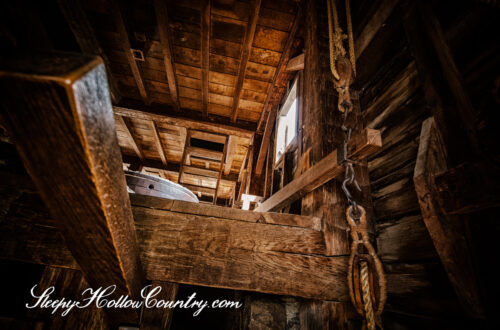
Most ancient monuments make you work for them. There are ferries, timed tickets, gift shops. North Salem’s Balanced Rock asks only that you pull over. It sits at 667 Titicus Road, a few feet from the pavement, beside a 19th-century carriage barn the town uses for storage. There is parking for a couple of cars, provided nobody gets ambitious.
What you get for stopping is a pink granite boulder, roughly 16 by 14 by 10 feet, resting on a few small limestone stones with daylight showing underneath. That is the whole attraction. Tripadvisor gives it four stars on the strength of five reviews. One reviewer budgets five to ten minutes for the visit, another says you needn’t stop at all, and a third sums it up as just a big rock. We wouldn’t dream of disagreeing. But it is a big rock with a long paper trail, and the paper trail is where things get interesting.
It is also, by some distance, North Salem’s mascot. As Phil Reisman reported in Westchester Magazine, a champion show horse was named after it, so was a second ballot line of the local Democratic party, and it serves as the logo of the North Salem News. Few boulders can claim a horse and a political party.
The barn beside it was built about 1869 by Stebbins B. Quick. In 1959 George H. Cable left the barn, the rock and 0.384 acres to the town, which declared it parkland of “historical and scientific” interest. The result is one of the smaller parks in Westchester, much of it occupied by the exhibit.
Nature or Art?
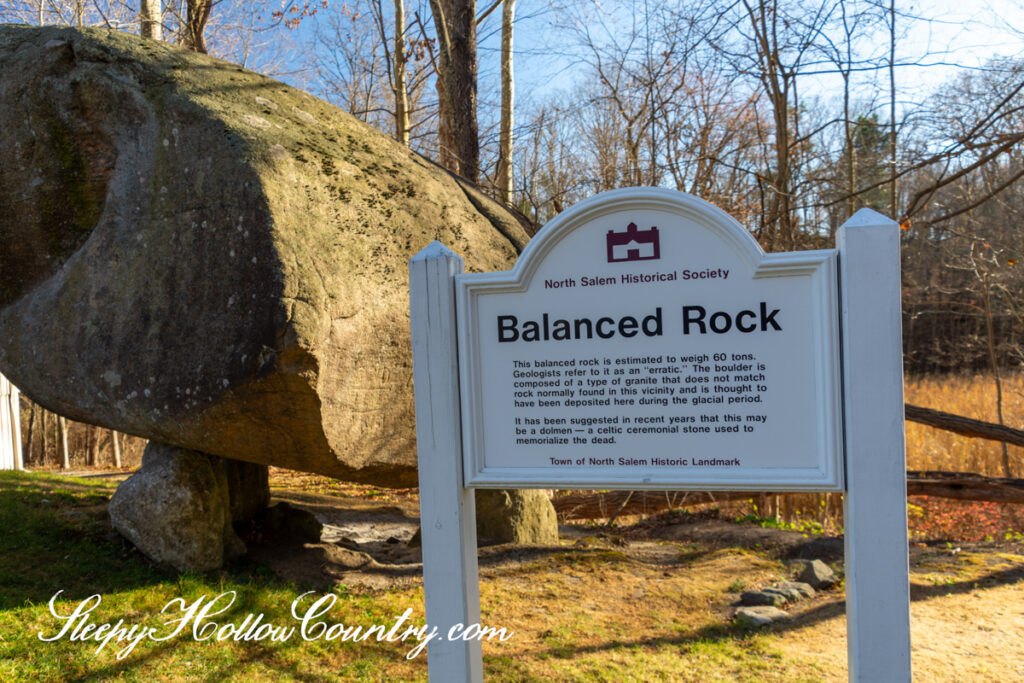
People have been asking who put the rock there since at least 1798, when Town Supervisor Daniel Delavan wondered whether it had been placed “by nature or by art.” More than two centuries later, the North Salem Historical Society’s sign beside the rock still hasn’t quite made up its mind.
Art found its first champion in 1824. John Finch, an English geologist and grandson of Joseph Priestley, was touring the young republic and lecturing on its rocks. In Benjamin Silliman’s American Journal of Science he published an essay “On the Celtic Antiquities of America.” According to later accounts, Finch argued that limestone never stands naturally above ground as pillars, so someone must have set the boulder on them, and North Salem must therefore have a Celtic monument.
Finch mailed a copy to James Madison, who replied with a masterclass in answering a crank theory politely. “Without venturing to decide on the validity of these ingenious Speculations,” the former president wrote, he respected their “philosophic & literary character.” He then raised the obvious question. Could simple monuments made of the most obvious materials turn up among different peoples simply because people everywhere face the same problems? In two sentences Madison anticipated most of the next two centuries of debate, and he was not even a geologist.
The historical marker says the dolmen idea has been “suggested in recent years.” Recent, presumably, by glacial standards.
The romantics soon followed. Robert Bolton, in his History of Westchester County (1848), thought that from the valley below the rock looked like a mammoth climbing the hill. He also supposed that Indian priests had read their tribe’s destiny in its weathered sides. He offered no evidence for either, though the mammoth is at least a matter of perspective. On October 28, 1875, a grandson of Chief Justice John Jay, recently back from Europe, told an audience that the rock closely resembled the dolmens he had seen abroad.
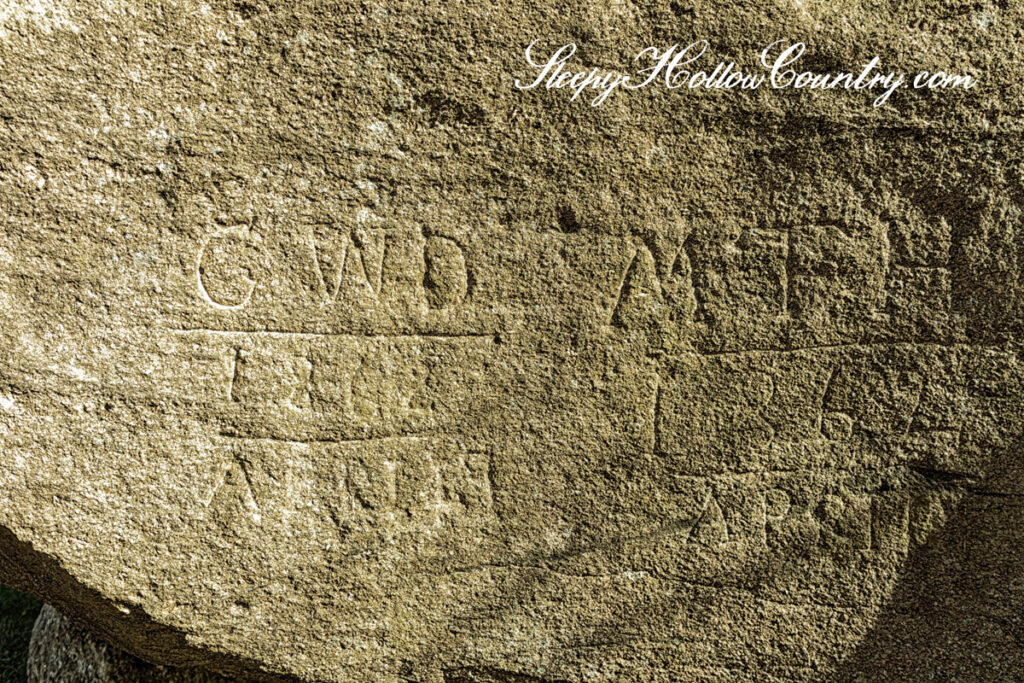
Meanwhile the locals did what locals do with a large, conveniently placed rock: they carved their initials in it. One barely legible date reads 1860-something. A 1906 postcard calls it simply “Large Boulder,” as though it had not yet settled on a stage name. By 1935 at least one newspaper reporter had heard the cynics’ theory that workmen had put it there, which is the only explanation in this story that has never had a fan club.
The Rock That Keeps Gaining Weight
The sign says the boulder weighs 60 tons, and nearly everyone repeats it. Not everyone, though. A caption accompanying a photograph credited to Barry Fell’s circle calls it a 90-ton capstone. One former neighbor, reminiscing in print, puts it at 175 tons. The Hudson Valley geologist Steven Schimmrich did the arithmetic for a granite block of those dimensions and got roughly 178 tons. He calls that an upper limit, since the rock is not a tidy box, but it is still about three times what the sign says.
The number of legs varies too. Depending on whom you read, the boulder rests on three supporting stones, or four, or five. The rock’s weight and footing seem to shift with the theory being advanced, which is more than can be said for the rock.
Enter the Druids
The Celtic theory lay quiet for a century and a half until 1976. That year Barry Fell, a Harvard marine biologist, published America B.C., which argued that Celts and Phoenicians had settled New England in the Bronze Age. Fell’s followers claimed North Salem’s rock as a dolmen, and an often-reproduced caption complains that it had been “incorrectly attributed” to the Ice Age. Smithsonian anthropologists Ives Goddard and William Fitzhugh reviewed Fell’s book in 1978 and found its arguments unconvincing, and most archaeologists agreed. The dolmen, however, had found its audience. The rock even appeared on the cover of an album by the Scottish folk musician Robin Williamson.
The internet gave the theory a second wind. In 2006 the British website The Megalithic Portal listed the “North Salem Dolmen.” The site’s own classification files it as a natural stone or glacial erratic. The contributor who posted it disagreed with that heading, leaned toward human construction, and later proposed the term “flying stone” for this kind of work. The comment thread since then has produced two compasses that disagreed with each other, a 2023 magnetometer reading described as anomalous, and a report that a car once crashed into the rock without moving it. The car, in our view, is the most persuasive witness.
The trouble with the dolmen is that it isn’t one. A dolmen is a tomb: a flat capstone set on three or more upright slabs, usually over a chamber built to hold the dead. North Salem’s rock is a rounded boulder sitting low on a few lumps of local stone. Its proportions are wrong, nothing has ever been found beneath it, and no one has produced any archaeological evidence that people were active at the site in ancient times. Admittedly, one Tripadvisor reviewer reports that you can crawl underneath it. So, presumably, can a woodchuck.
And Then, Inevitably, the Aliens
No ancient-mystery theory in the Hudson Valley stays earthbound for long. When Reisman visited, a party of believers arrived by SUV and told him the Balanced Rock and the stone chambers of nearby Putnam County had been sending signals into space. They linked this to the thousands of UFO sightings reported across the region in the 1980s.
The History Channel’s Ancient Aliens came to town for an episode titled “The Druid Connection.” Its presenters, David Childress and Hugh Newman, declared the rock identical to a British dolmen, and Whitley Strieber counted it among the great structures of the past. The skeptic Jason Colavito reviewed the episode and described the site as “just a rock on the side of the road next to somebody’s garage.” In fairness to the rock, the garage is a town-owned carriage barn, and it is older than the theory.
The town historian, Susan Thompson, declined to be interviewed for the program because she didn’t want to be associated with it. She told Reisman she will talk to anyone about the rock, whatever they believe.
What the Geologist Says
The sign beside the rock, before it gets to the dolmen, gives the dull answer: the boulder is a glacial “erratic.” Its granite doesn’t match the rock normally found in the vicinity, and it was probably dropped here during the glacial period. Schimmrich, author of Geology of the Hudson Valley, fills in the details.
- The boulder is weathered pink granite. The color comes from potassium feldspar.
- The supports look like limestone or dolostone, possibly of the Wappinger Group.
- How it got there: continental ice sheets carried the boulder south during the last ice age. When the ice melted, it was set down on whatever rocks happened to lie beneath it.
- The evidence: the lowest support stone bears glacial striations, scratches gouged by rock dragged along under moving ice.
That last point disposes of Finch. His limestone “pillars” are just limestone that was underneath when the ice let go. And they carry the ice’s own scratch marks, which is about as close to a signature as a glacier ever leaves.
Schimmrich also ran a field test. He reports that his children couldn’t push the rock over. In a spirit of open inquiry he tried to draw some psychic energy from it, and filed his findings: “My chakras are still tingling.” He points out that balanced erratics are found all over the glaciated world. Finland’s Kummakivi is larger and even more precarious. The Finns traditionally credited it to trolls and giants, which at least has the merit of being honest folklore.
The One That Got Away
Not every balanced rock in Sleepy Hollow Country has been so lucky. Across the Hudson in Nyack, a similar “Balance Rock” was jackhammered apart in the 1960s for fear it would roll onto cars below. North Salem’s has seen off the stagecoaches, the 1860-something vandal, John Finch, Barry Fell, the History Channel and at least one automobile, and it is still sitting there.
The real mystery of the Balanced Rock isn’t how it got there. A glacier answered that question about 15,000 years ago and has been waiting patiently ever since for us to accept it. The mystery is why, for two centuries, so many people have badly wanted someone to have put it there. Thompson may have the best explanation. She calls the rock “mysterious and charming – in a world that mostly isn’t at the moment.” On that point, at least, the geologists, the Druid enthusiasts and the woodchuck can all agree.

Jim Logan
By day, Jim Logan is superintendent of Sleepy Hollow Cemetery, a position that requires him to keep excellent company with the permanently quiet residents of one of America's most storied burial grounds. A fifth-generation Tarrytowner, Jim might reasonably expect this pedigree to lend him a certain air of historical gravitas—and in most towns, it would. But when your job regularly puts you in contact with families whose ancestors were already well-established here when the Dutch were still running things, five generations starts to feel like you just moved in. By night—and weekends, and probably lunch breaks—he's a historian with an unhealthy appetite for crumbling newspaper archives and forgotten local lore. After more than two decades of research, Jim has assembled a formidable collection of Sleepy Hollow and Tarrytown historical resources, which he mines for the stories that appear on Sleepy Hollow Country. If there's a ghost with a tale to tell, a legend with a plot hole, or a 19th-century scandal gathering dust in the archives, he'll find it.