The Bewitched Mill of Sing Sing
The tale of the bewitched mill of Sing Sing comes to us down a winding path—from ancient campfires at the now-vanished shad fishing camp at Crawbucky Point, through newspaper archives, to a battered 1922 pamphlet in the Westchester County Historical Society. It’s the kind of story that reveals as much about how folklore travels as it does about witches and mills.
First, a quick note on names: the village we now call Ossining was known as Sing Sing until 1901, when locals, weary of being associated with the infamous prison, opted for a different anglicization of the Mohegan ‘Sint Sinck.’ In our tale, Sing Sing refers to the village, not the prison.
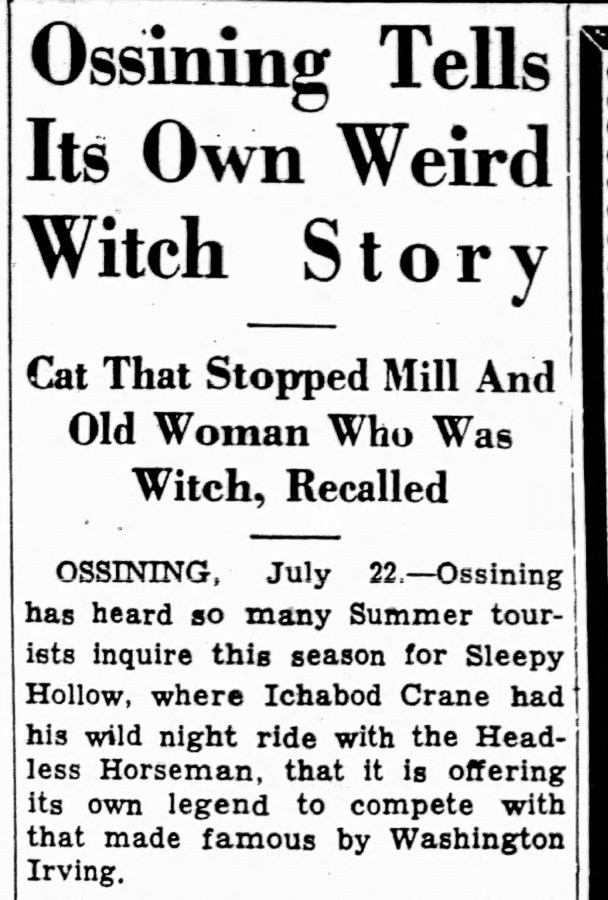
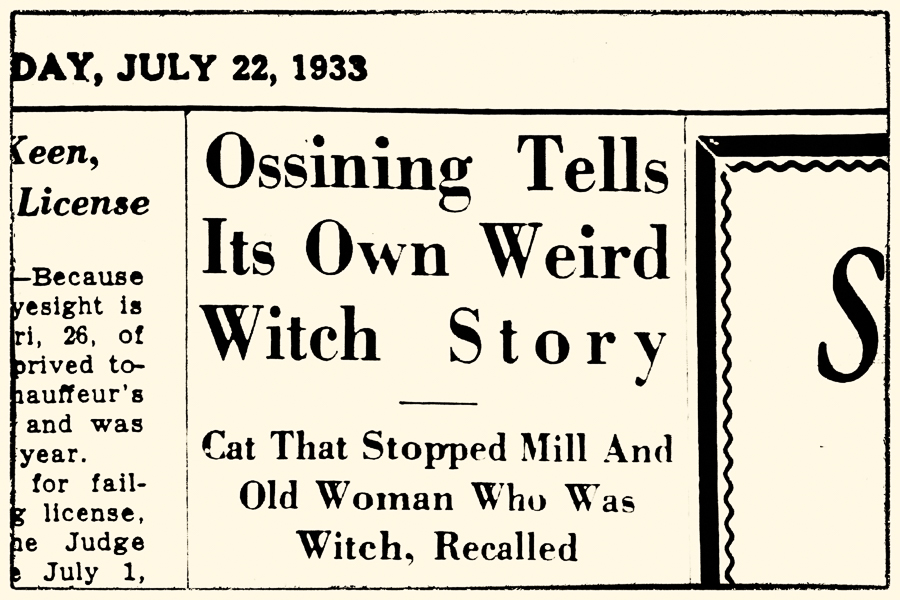
Now back to the story of the Ossining witch. We first encountered this tale in an unlikely place: a July 22, 1933 article in The Daily Item of Port Chester, New York. Under the headline “Ossining Tells Its Own Weird Witch Story”, the unnamed reporter described a village mildly annoyed at being upstaged by a rival village known for a Headless Horseman: “Ossining has heard so many Summer tourists inquire this season for Sleepy Hollow, where Ichabod Crane had his wild night ride with the Headless Horseman, that it is offering its own legend to compete with that made famous by Washington Irving.”
There’s a layered irony here. In 1901, Sing Sing changed its name to Ossining to escape association with the prison. By 1933, Ossining found itself envying a fictional story’s fame—the very same fame that would later convince North Tarrytown to rebrand itself as Sleepy Hollow in 1996. One village fled notoriety, another would chase it, and here was Ossining in between, dusting off its own witch tale to compete.
The article recounts the tale of an old mill formerly located in “what is now a thriving business section” that had a rash of mechanical issues, all occurring at the stroke of midnight. The miller, convinced that something more than just a bad gear was at play, decided to take matters into his own hands.
As the clock struck twelve, in ran the culprit: a cat. Not just any cat, mind you, but one with the audacity to stroll through the grain hopper like it owned the place. The miller, in a mix of terror and annoyance, shot at the feline. The cat escaped, but not before leaving behind a bit of evidence—a trail of blood from an injured paw.
For days afterward, a ‘certain ancient dame’ in the nearby hamlet of Sparta went around with one arm in a sling, avoiding the streets after dark—apparently wary of neighbors who had long suspected her of witchcraft.
Was there an Ossining Mill?
Naturally, this got us wondering: was there actually a grain mill in downtown Ossining? Without a mill, the whole story would crumble like… well, like poorly ground flour.
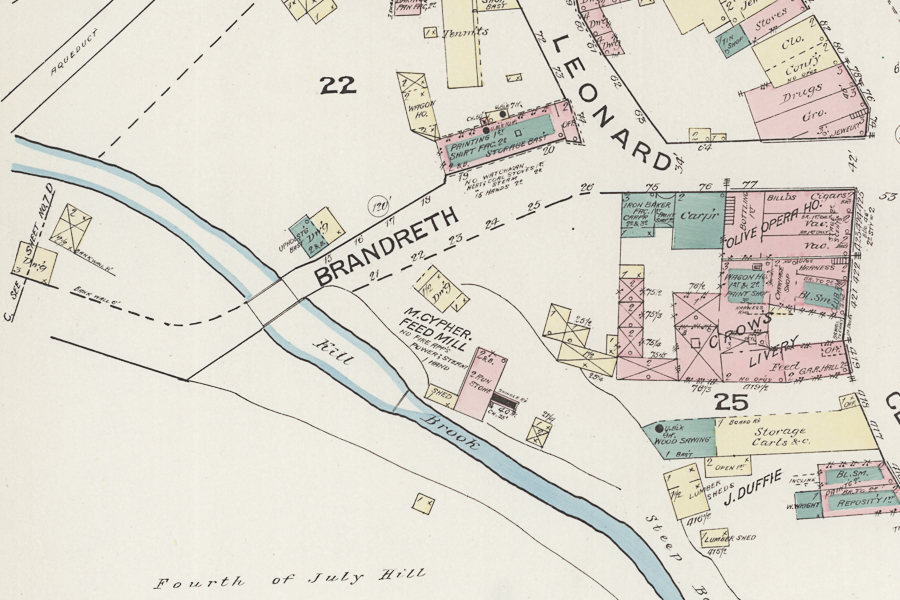
We turned first to the collection of Sanborn fire insurance maps at the Library of Congress. Sure enough, the 1886 Sanborn series documents the M. Cypher feed mill on the ‘Kill Brook’ just below Brandreth Street—’kill’ being the Dutch word for creek, making ‘Kill Brook’ delightfully redundant. It would have been located a little below today’s Full Gospel Tabernacle Church, but no remnants of the structure survive today.
Searching the Archives for an Ossining Witch
With the presence of a mill established we next sought out additional newspaper reports on the Ossining witch story. Finding no additional newspaper accounts in our usual sources, we expanded our search to the archives of the Westchester County Historical Society, where we struck gold: a battered copy of a 1922 pamphlet titled Reminiscences of Ossining. This brief collection of history and legends was compiled and edited by Florence Leary Reynolds, historian of the Mohegan Chapter of Daughters of the American Revolution. It was published by The Moran-Register Press of Ossining, NY. In it appeared a vignette titled “The Legend of the Bewitched Mill”.
The unnamed author sets the scene perfectly: a group of fishermen at the shad camp on Crawbucky Point, waiting for the tide to turn, swap stories after dinner. When one fisherman remarks that his pocket watch must be bewitched—it keeps stopping at a certain hour—an old timer perks up. That punctuality, he says, reminds him of an old mill on the Sing Sing Kill that was known to break down every night at midnight.
What follows is the complete account, told as it was heard from the old fishermen of Crawbucky Point.”
On one of these long ago visits of the Sing Sing boys on the beach after the combined feast of visitors and hosts had been duly discussed and found good, the casual remark of one of the company that his watch must be bewitched (it had got in the habit of stopping at a certain hour), brought forth response from one of the old fishermen that the watch must be “like the old mill up in Kil Brook my father used to tell about, which once upon a time got to stopping every night at twelve o’clock.”
Of course, everyone present wanted to know what happened to the mill, and the tide not yet being right to begin work of drawing the seine, “everyone present” was accommodated with story here told, not in the picturesque words of the old fisherman, but as best memory can recall the principal features of
The Legend of The Bewitched Mill
Years and years ago, before the railroad with its embankments and depots, its shrieking locomotives and rumbling cars, brought Sing Sing within an hour’s ride of the metropolis and drove every bit of romance from the east shore of the Tappan Zee; before gas was known or telegraphy thought of, Sing Sing was a market town of some importance to the farmers the country ’round, and the grist mill, situated on the Kil, a little below the present site of the gas house, had a very high reputation for the good quality of its work, and was, consequently well patronized by all who had grain to be ground.
At certain seasons of the year there was so much to do that it was necessary in order to do all that was required, to run the mill night and day. It was during one of these busy seasons that a series of singular coincidences occurred: At midnight, just on the last stroke of twelve, the mill would stop, and vain were all efforts to induce it to go until morning. As might be supposed, every part of the machinery was overhauled, oiled and repaired; but all to no purpose. At twelve o’clock every night, stop the mill would, and nothing but daybreak would set it going again.
The miller was sore perplexed at this unwonted behavior on the part of the mill, and, after long pondering during which its nightly stoppings continued, concluded that the mill was bewitched, and that the hopper thereof was the particular portion affected.
Accordingly, the miller resolved to watch the hopper at night and note occurrences carefully. The night he had chosen was dark and stormy but armed with lighted lantern, a Bible and a shotgun, he determinedly took his position and awaited developments.
Slowly the hours went by; nothing to be heard but the monotonous clang of the mill, howls and shrieks of the storm and rustlings of rats and mice. Lonesome enough was the miller, you may be sure; and as the mvstic hour of midnight approached, with equal reliance did grasp both Bible and gun. Imagine his surprise when, on the first stroke of twelve from the old dock in the mill office, he beheld an immense black cat, with an unearthly howl, bound through a broken window and run around the hopper. The mill immediately stopped, and the cat, completing the circuit, with another howl made for the window. Before she reached it the miller had recovered from his surprise sufficiently to take hasty aim with his gun the fire at the retreating animal, and with some effect; for though the animal escaped, yet bloody proofs were found on the sill that one of its paws had been broken by the shot.
As a sequel it was stated that the mill ever after did its work without any more mysterious and periodic stoppings, and that a certain ancient dame, who lived down towards Sparta, long suspected of being a witch, for a long time after, and commencing with the very morning after the shooting of the cat by the miller in the old mill, wore her arm in a sling with her hand bandaged.
So what did we learn? That the Bewitched Mill tale has a documented pedigree going back at least to 1922, likely much earlier. That there really was a mill on Sing Sing Kill where the story is set. And that Ossining, tired of living in Sleepy Hollow’s shadow, has its own shapeshifting witch to offer—even if she preferred feline form to headless horseback. Whether the ‘ancient dame’ of Sparta ever existed is lost to time, but the story itself has proven remarkably durable, grinding away in the collective memory long after the mill itself has vanished.
Know of a bewitched building we’ve missed? Our millstones are always ready to grind out another tale. Email us at ghost.editor@sleepyhollowcountry.com.

Jim Logan
By day, Jim Logan is superintendent of Sleepy Hollow Cemetery, a position that requires him to keep excellent company with the permanently quiet residents of one of America's most storied burial grounds. A fifth-generation Tarrytowner, Jim might reasonably expect this pedigree to lend him a certain air of historical gravitas—and in most towns, it would. But when your job regularly puts you in contact with families whose ancestors were already well-established here when the Dutch were still running things, five generations starts to feel like you just moved in. By night—and weekends, and probably lunch breaks—he's a historian with an unhealthy appetite for crumbling newspaper archives and forgotten local lore. After more than two decades of research, Jim has assembled a formidable collection of Sleepy Hollow and Tarrytown historical resources, which he mines for the stories that appear on Sleepy Hollow Country. If there's a ghost with a tale to tell, a legend with a plot hole, or a 19th-century scandal gathering dust in the archives, he'll find it.