Sleepy Hollow’s Spook Rock
On the west side of Rockefeller State Park Preserve, a short walk from the Witch’s Spring and within earshot of Route 117, lies a large, flat boulder called Spook Rock. Nearly every account of how it got the name leads back to one book: Edgar Mayhew Bacon’s Chronicles of Tarrytown and Sleepy Hollow (1897).
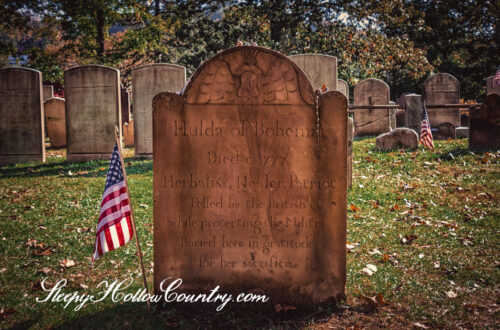
Regular readers know Bacon as the man who gave Sleepy Hollow its witch, Hulda. He places Spook Rock “not far from the cottage of Hulda, the witch,” which is a bit like giving directions by a landmark you built yourself.
Bacon’s star maiden
Bacon starts with his credentials. Tarrytown’s old farmers were “not given to romancing and the inveterate foes of novelty.” And “some elderly folk, whose memories take them back to the thirties,” had the story from their parents and grandparents, “which should satisfy any sceptic of its genuine antiquity.” Keep that decade in mind.
The rock, he says, was “an Indian shrine” where Lenape sachems held council. One night a young hunter finds a dozen heavenly maidens dancing on it around a great basket, “which, as every one knows, is the approved vehicle when heavenly maids pay a visit earthward.” He cries out, and they flee back into the sky, toward a large star. On a later night he pounces and carries off the most beautiful as his wife.
They have a child. Three years on, she hears her sisters singing and vanishes. The baby dies, the hunter walks off for good, and the lodge falls in. When she comes back, convinced she has been gone only a few hours, she finds bare poles. She has been searching the Pocantico woods on spring nights ever since. Lights, Bacon adds, have been seen near the rock “within the present generation.”
A basket from the sky
Anyone who read Indian legends in the 1890s had met this one before. In 1839 Henry Rowe Schoolcraft published “The Celestial Sisters” in Algic Researches and labeled it Shawnee. In it a hunter named Waupee finds a ring worn into a prairie and watches twelve star sisters come down in a basket to dance there. After several tries, once disguised as a mouse, he captures the youngest. They marry and have a son, until homesickness carries her back to the sky.
The story was everywhere. Schoolcraft reprinted it in 1856 in The Myth of Hiawatha, and that same year Cornelius Mathews made it the frontispiece story of his often-reissued Indian Fairy Book. It belongs to a family of tales found from Ireland to Japan that folklorists call the swan maiden: a man captures a woman from another world, and she escapes back to it. So it is a genuine Native story type, but not one anybody collected in Sleepy Hollow.
Moving in
Bacon seems to have taken a story everyone knew and laid it over a boulder down the road. He made the changes you would make to bring a legend home:
- A new address. The prairie became the Pocantico, the Shawnee became the Lenape, and the ring in the grass became a council rock. We have found nothing before Bacon that calls the rock a shrine.
- More grief. Schoolcraft’s family ends up reunited in the sky. Bacon’s ends with a dead baby and an empty lodge.
- Fairy time. His star wife thinks she has been gone a few hours when years have passed. That comes from European fairy lore, not from Schoolcraft, and the Hudson already had its most famous case in Rip Van Winkle.
- A spook. A star-maiden tale needs no ghost, but a rock called Spook Rock does, and Bacon’s ending supplies one.
His own voice gives him away, too. No ancient tradition compares fleeing maidens to society girls who “would fain go a-slumming.” And those elderly folk whose memories reached back to the thirties? Schoolcraft published in 1839.
But Bacon’s chapter has a bigger problem than its sources. It is not the first word on Spook Rock.
A year early, and a different ghost
Most later retellings treat Bacon’s Chronicles as the headwater: the place where Spook Rock was first set down in print. It was not. A full year before Bacon published, the rock had already reached the New York newspapers, lights and all.
Only one thing was missing from those earlier accounts: the star maiden. The ghost haunting Spook Rock in 1896 was no grieving bride from the heavens. It was a murdered pirate.
Enter Captain Kidd.
On February 14, 1896, a telegraph from Scarborough reached the New York Herald. For several days, it said, parties of New York prospectors had been turning up in search of Kidd’s treasure. The local tradition, as the Herald told it, was that Kidd had sailed up the Hudson and anchored about where Mr. Rockefeller’s boathouse now stood. He had then carried part of his loot inland to Spook Rock and buried it underneath. Then he followed standard pirate procedure: he killed one of his men and left the ghost behind to stand guard. The ghost had been wailing at the neighborhood farmers ever since.
A month later The Press sent its Tarrytown correspondent and came back with a fuller, and considerably grimmer, account of how that guard was appointed. That story will keep for another day. The two papers do agree on what happened when the diggers got down to business. Deep in the hole they struck an iron-bound chest. The moment they tried to lift it, their lights went out. When they could see again, the chest was gone. Irving’s money-diggers had much the same luck in 1824.
The rock stood on William Rockefeller’s land near Gory Brook, and the oil millionaire was not charmed. His watchmen ran off a party of Tarrytown men, and notices forbidding trespass went up on the trees. Mr. Rockefeller, the Herald reported, “has had enough of it.” The rest of the country had not: the story went out on the wires to Indianapolis, Sioux City, Wheeling and the farmers of South Dakota.
So in the winter of 1896, Spook Rock had a pirate, a buried chest, a murdered guardian, moaning in the night and mysterious lights. Twelve months later Bacon gave it a star maiden, kept the lights, and let Kidd vanish as completely as the chest. It was not that Bacon had anything against pirates. The same book gave Kidd a secret rendezvous at Kingsland Point. Why he traded a cutthroat for a celestial bride at Spook Rock is a question for another time.
Every retelling since has followed Bacon, and the pirate has dropped out of the story altogether. The lights, apparently, are still out there on spring nights. Mr. Rockefeller’s watchmen have since given way to New York State Parks, which takes an equally dim view of shovels.
Know of a ghost whose story we should tell? Please write us at ghost.editor@sleepyhollowcountry.com.

Jim Logan
By day, Jim Logan is superintendent of Sleepy Hollow Cemetery, a position that requires him to keep excellent company with the permanently quiet residents of one of America's most storied burial grounds. A fifth-generation Tarrytowner, Jim might reasonably expect this pedigree to lend him a certain air of historical gravitas—and in most towns, it would. But when your job regularly puts you in contact with families whose ancestors were already well-established here when the Dutch were still running things, five generations starts to feel like you just moved in. By night—and weekends, and probably lunch breaks—he's a historian with an unhealthy appetite for crumbling newspaper archives and forgotten local lore. After more than two decades of research, Jim has assembled a formidable collection of Sleepy Hollow and Tarrytown historical resources, which he mines for the stories that appear on Sleepy Hollow Country. If there's a ghost with a tale to tell, a legend with a plot hole, or a 19th-century scandal gathering dust in the archives, he'll find it.