The Woman in Black
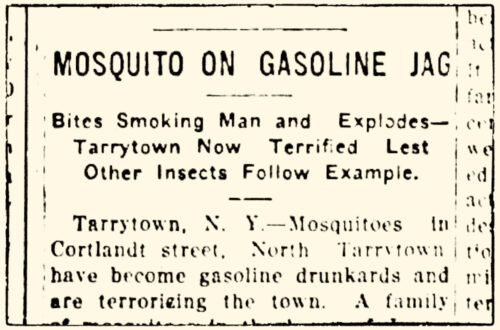
Sleepy Hollow has never been short of women in white. Washington Irving supplied one in 1820: she haunted the dark glen at Raven Rock and shrieked on winter nights before a storm. In the last week of January 1899, Sleepy Hollow (then called North Tarrytown) got a woman in black. For six nights she was far more frightening than Irving’s, because nobody seemed to have made her up.
Monday
It began around midnight on Monday, January 23, 1899. Wesley Van Tassel (a name that would be a bit much in fiction) and some friends were walking home along Beekman Avenue when they noticed a woman standing in front of Farrington’s drug store. She was dressed in deep black and her face was covered. As they got nearer she stepped into the doorway. As they passed she turned her head away, so that none of them saw her face. One hand stayed hidden under her shawl.
It was twelve o’clock at night, and respectable women did not, as a rule, wait in drugstore doorways at that hour. The young men remarked on it. Then they told their friends, and by the next night the police and a good many of those friends were out looking for her.
The week
She did not disappoint them. Over the following nights she was seen coming out of Sleepy Hollow Cemetery, standing on Beekman Avenue, and most often in Beekman Walton’s yard, which she seemed to favor. On Tuesday night a heavy thunderstorm broke over the village and she was out anyway; some said they saw her coming from the cemetery in it. The White Plains Eastern State Journal later tallied her other appearances. She stood in a yard. She lay, apparently asleep, in a gutter. She waited behind a tree “as if waiting for some one.”
The hidden hand became the center of the whole affair. To an 1899 newspaper reader, a veiled woman with a concealed hand suggested one thing: vitriol. Throwing sulfuric acid in someone’s face was a crime the papers of the day reported often and in detail. North Tarrytown concluded that it had a vitriol thrower, and that she kept the bottle under her shawl. Nobody knew whom she was waiting for, so it could be anyone.
The village shut itself in. Doors were kept locked day and night. Children were not allowed out after five o’clock. Men and boys stayed home unless their business was urgent, and the Paterson Call reported, with something like wonder, that “The husbands actually stayed home with their wives.” The streets emptied after dark. On Wednesday night mothers would not let their sons go to see their sweethearts, and romance in North Tarrytown was suspended until further notice. The police, meanwhile, were fretting about their failure to catch her.
On Friday the threat seemed to become real. Word reached Chief Minnerly that Joanna Murphy, “one of North Tarrytown’s fairest daughters,” had met the woman in black and that acid had been thrown at her. Fortunately it had missed her face. The chief called on Miss Murphy and found there was nothing to the story. That did not help much. A rumor that has been disproved still travels faster than the correction.
Saturday night
The climax came late on Saturday, January 28. Chief Minnerly was behind his desk at police headquarters, smoking his pipe, when Paul Birdsall and a friend ran in, out of breath. The woman in black had been found. She was in Beekman Walton’s yard.
The chief put on his hat and hurried over. At the yard he found at least thirty men and boys standing around at what they evidently judged a safe distance. Not one of them had gone near her. And there she was, sitting on a woodpile, all in black.
At this point the Call‘s correspondent rose to the occasion, and he deserves to be quoted in full:
He expectorated on his hands, took an extra grip on his club and a hitch in his trousers, and then forwarded march.
The crowd stood “spellbound and trembling.” Just then Edward Minnerly came downstairs. Rumor said the woman had been after him, and he had not left the house after dark all week. He caught one glimpse of her, gave a shriek, and went back up the stairs three steps at a time. (The Call does not say whose stairs they were, or whether Edward was related to the chief. For the sake of family dinners, one hopes not.)
Chief Minnerly walked up to the woman without the least hesitation, took hold of her arm, and gave it a shake.
Something parted. The arm came away from the body.
She was a stuffed figure in women’s clothes. The thirty men, who had been waiting to hear the chief cry out as the vitriol hit him, “came sneaking up.” The chief, in the Call‘s words, “gave them the laugh.” The Eastern State Journal adds that Minnerly walked back to the station “with the woman on his arm,” which put him ahead of every other man in the department, none of whom had got that close to her all week.
Aftermath
The police blamed boys. Someone had been carrying the dummy around the village at night, planting it where it would be seen, and getting it away again before the police arrived. Nobody was named and nobody was arrested.
The Call reported that the mystery was solved “as far as the police are concerned,” but that the women of the village were “still living in fear and will not be consoled.” It closed with an odd remark: the police believed the woman in black to be “one of Tarrytown’s widows.” Presumably this meant that her clothes were a widow’s mourning black, borrowed for the purpose, and not that a Tarrytown widow had been stuffed. We hope.
How she grew
The story went out on the wire, and the further it went the better she got. The Albany Times-Union and the Nyack Evening Star ran the plain version: the drug store, the thunderstorm, the woodpile, and the arm. They left out the expectoration and Edward Minnerly, which is their loss.
The New York Journal, William Randolph Hearst’s paper and never one to leave a story as it found it, improved on everyone. In its version Farmer Wesley Van Tassel saw her on Friday sitting on a stone fence by the bridge over the Pocantico, “where the headless horseman overtook Ichabod.” Chief Minnerly led a squad of five men on a long hunt and finally cornered her on the cemetery’s stone fence, where he ordered: “Stop or I’ll shoot.” She turned out to be a dummy with wires attached to her limbs, which, the Journal explained, accounted for her “peculiar motion.”
Nobody else saw any wires, or any motion at all. A wired puppet would also have needed a puppeteer standing somewhere in the crowd, and the Call‘s version of her lost an arm to a single shake. The Journal‘s woman in black did not need wires to move. She had the Journal.
Coda
Of Sleepy Hollow’s two women, the one in white has gone on shrieking at Raven Rock for two centuries without anybody laying a hand on her. The one in black lasted six nights. The first man to lay a hand on her came away holding her arm.

Jim Logan
By day, Jim Logan is superintendent of Sleepy Hollow Cemetery, a position that requires him to keep excellent company with the permanently quiet residents of one of America's most storied burial grounds. A fifth-generation Tarrytowner, Jim might reasonably expect this pedigree to lend him a certain air of historical gravitas—and in most towns, it would. But when your job regularly puts you in contact with families whose ancestors were already well-established here when the Dutch were still running things, five generations starts to feel like you just moved in. By night—and weekends, and probably lunch breaks—he's a historian with an unhealthy appetite for crumbling newspaper archives and forgotten local lore. After more than two decades of research, Jim has assembled a formidable collection of Sleepy Hollow and Tarrytown historical resources, which he mines for the stories that appear on Sleepy Hollow Country. If there's a ghost with a tale to tell, a legend with a plot hole, or a 19th-century scandal gathering dust in the archives, he'll find it.